
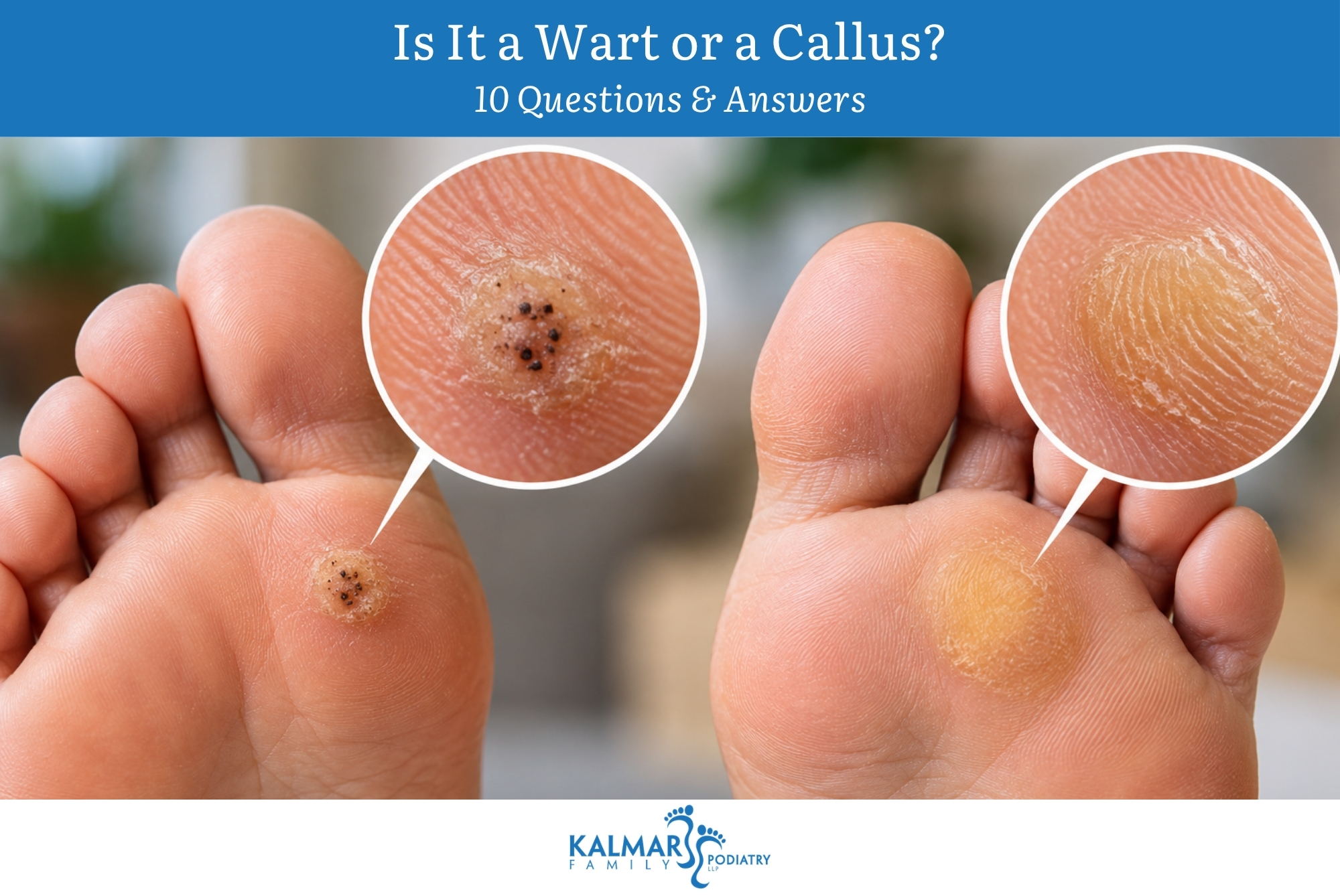
- How can I tell if I have a wart or a callus?
A callus is usually a broad area of thickened skin caused by repeated pressure or friction. A plantar wart is caused by a virus (HPV) and may appear as a rough, grainy growth on the bottom of the foot. Plantar warts can also develop a layer of callused skin over them, making them difficult to identify without an examination.
- What does a plantar wart look like?
A plantar wart often appears as a rough or thickened spot on the sole of the foot. Small black dots may be visible within the wart. These dots are tiny blood vessels that can become visible within the wart tissue.
- What does a foot callus look like?
A foot callus typically looks like a thick, hardened, rough area of skin. It commonly develops on parts of the foot that experience repeated pressure or friction, including the heel, ball of the foot, or sides of the toes.
- Does a wart hurt differently from a callus?
It can. A callus is generally most uncomfortable when direct pressure is placed on the thickened area. A plantar wart may hurt when the area is squeezed from the sides or when walking places pressure on the wart. However, pain alone cannot reliably determine whether a lesion is a wart or callus.
- Do warts have black dots?
They can. Small black or dark pinpoint spots are a common characteristic of plantar warts and represent blood vessels within the wart. However, not every wart will have obvious black dots, so their absence does not necessarily rule out a wart.
- Do skin lines go through a wart or a callus?
Skin lines generally continue through a callus, while the normal skin lines may be interrupted by wart tissue. This can be a useful clue when distinguishing between the two, but it is not a substitute for a professional diagnosis.
- Can a wart have a callus over it?
Yes. Plantar warts can develop beneath a layer of thickened skin, which is one reason they are sometimes mistaken for ordinary calluses. If a supposedly routine callus is painful, keeps returning, or does not improve when pressure and friction are addressed, it may be worth having a podiatrist examine it.
- Are foot warts contagious?
Yes. Plantar warts are caused by human papillomavirus (HPV) and can spread to other areas of the body or to other people. Avoid picking or scratching a suspected wart, and wear footwear in communal areas such as locker rooms, pools, and public showers.
- Should I remove a wart or callus at home?
It is best to use caution with at-home removal. Cutting or shaving a callus yourself can create an open wound and increase the risk of infection. Kalmar Family Podiatry specifically advises against using blades or other devices to remove calluses at home. This is especially important for people with diabetes, circulation problems, or reduced sensation in their feet.
- When should I see a podiatrist for a wart or callus?
Consider seeing a podiatrist if you are unsure whether you have a wart or callus, if the area is painful, keeps returning, interferes with walking, or does not improve with appropriate foot care. Professional evaluation is particularly important if you have diabetes, neuropathy, or circulation problems. At Kalmar Family Podiatry in Huntington, NY, our podiatrists can evaluate the area and determine whether you have a callus, plantar wart, corn, or another foot condition.
Wart or Callus? Get the Right Diagnosis
A thickened spot on your foot isn’t always easy to identify on your own. Plantar warts and calluses can look similar, and a wart may even develop beneath thickened skin.
If you’re unsure what you’re dealing with, the podiatry team at Kalmar Family Podiatry in Huntington, NY can examine the area and recommend the appropriate treatment. The practice also offers advanced treatment options for persistent plantar warts, including Swift Microwave Therapy.